
Why 'Early Voting,' and 'Late Voting,' are both Unconstitutional
And here are the specific Constitutional clauses and Federal laws that say so, along with very clear and authoritative definitions of the relevant terms.

Elections for members of the Electoral College (“Electors”)
The President of the United States is chosen by the Electoral College, which is composed of what are called “Electors,” who each are allowed one vote for President.
Per the US Constitution, some number of Electors are chosen by the legislature of each State—either directly by vote of the State legislature, or indirectly by some means as specified by State law. Each State legislature has plenary (non-judicially reviewable) Constitutional authority to choose Electors by whatever means they might desire.
Modernly, Electors are chosen by popular vote in each State, as set forth by the election laws of the State they represent—typically, by statewide popular vote, although some States do it by Congressional district, instead. The number of Electors that each State is allowed to send to the Electoral College is determined based on the most-recent national census. That’s all as specified by the US Constitution, and by the laws of each State.
The time when, and the manner by which, Electors must be chosen is specified by the US Constitution in Article II, § 1, pa. 4:
The Congress may determine the Time of chusing the Electors, and the Day on which they shall give their Votes; which Day shall be the same throughout the United States.
Congress has, in fact, determined by law the time at which Electors must be chosen, via US Code, Title 3, Chapter 1, §1 - Time of appointing electors:
The electors of President and Vice President shall be appointed, in each State, on election day, in accordance with the laws of the State enacted prior to election day.
Because Electors are currently chosen by popular vote, that means that Presidential Electors must all be chosen on a single day, which must be the same day nationwide.
Elections for other Federal offices
The Constitutional requirements for elections for all other Federal offices are specified in Article I, § 4:
The Times, Places and Manner of holding Elections for Senators and Representatives, shall be prescribed in each State by the Legislature thereof; but the Congress may at any time by Law make or alter such Regulations, except as to the Places of chusing Senators.
That means that, for all other Federal offices, either each State legislature, or else Congress, must specify the times and places when elections for Federal office must occur. Congress has in fact done so:
Title 2 U.S. Code § 7 - Time of election:
The Tuesday next after the 1st Monday in November, in every even numbered year, is established as the day for the election, in each of the States and Territories of the United States, of Representatives and Delegates to the Congress commencing on the 3d day of January next thereafter.
The fact that the Federal law on the matter requires that Federal elections must occur on a specific day of the week (Tuesday) eliminates any possibility that the word ‘day’ means anything other than a 24-hour calendar day.
Why does the Constitution, and Federal law, require that elections must occur on a single day?
The reasons are as follows:
To reduce the risk of manipulation or corruption of the process. As Governor Morris stated at the Constitutional Convention: "As the Electors would vote at the same time throughout the U.S. and at so great a distance from each other, the great evil of cabal [collusion for nefarious purposes; conspiracy to corrupt the process] was avoided. It would be impossible to corrupt them."
Limiting the window of time during which votes are cast prevents coordination or collusion for corrupt, dishonest purposes between electors in different states. Justice Joseph Story noted this provision was "calculated to repress political intrigues and speculations, by rendering a combination among the electoral colleges, as to their votes, if not utterly impracticable, at least very difficult."
The same reasoning applies to the issue of attempts by one precinct or county to include fraudulent ballots, or exclude legally-valid ones, in order to change which candidate (or proposition) is deemed to have won the election. The greater the time differential between when votes are cast at different locations, the easier it is to coordinate and collude between different precincts, counties or states for the purpose of subverting the actual will of the people:
If cheaters don’t know how many fake ballots would probably be needed, or how many valid ones would probably need to be “lost,” in order to achieve their desired result, they would generally have to risk a greater magnitude of cheating in order to be sure of success. The more fake ballots that are needed to be inserted into the count, or the more valid ones need to be improperly removed, in order to change the outcome, the greater the probability of (unwanted!) detection.
Based on that, it would also be advisable to synchronize the time when voting precincts report their results to the county and/or secretaries of state. No precinct should publish or report its results until ALL precincts are ready to do so. The level of security and audit required to ensure this is done synchronously by every precinct, without any leaks to anyone whatsoever, should be extremely high. Currently, our system is far from that standard.
With respect to elections for any Federal office, Federal law supersedes and overrides State law
The US Constitution (Article VI, clause 2) explicitly states that any laws enacted under the authorities granted to Congress by the Constitution override the laws of any State:
This Constitution, and the Laws of the United States which shall be made in Pursuance thereof; and all Treaties made, or which shall be made, under the Authority of the United States, shall be the supreme Law of the Land; and the Judges in every State shall be bound thereby, any Thing in the Constitution or Laws of any State to the Contrary notwithstanding.
Note that the relevant clauses of the Constitution on the subject of elections and voting explicitly grant Congress plenary authority over some aspects of how elections may be conducted—including the times, places and manners of holding elections.
What is an ‘election’?
Here’s the dictionary definition of ‘election’:
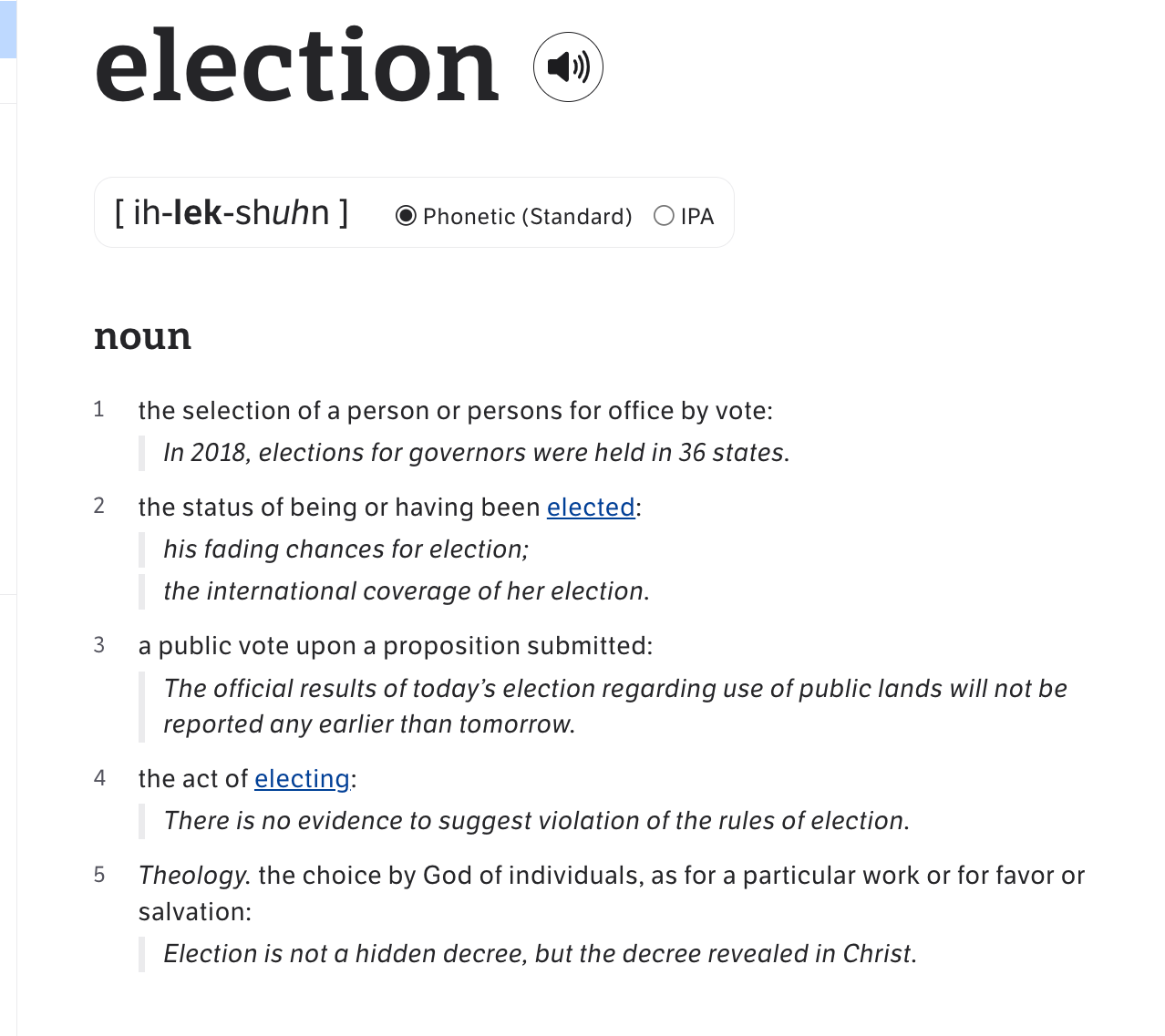
An ‘election’ is not just a process or procedure in which votes are counted. In fact, it is primarily defined semantically as the casting of votes, and not the counting of them. It still would semantically qualify as an ‘election’ even were the votes never counted. Conversely, “counting votes” that were never cast does not semantically qualify as an ‘election,’ other than as a fake or fraudulent one.
Were that not the case, then no votes could legally be counted other than during the 24-hour period proscribed by law for conducting an election. It would be nonsensical to impose any such requirement, given the probability that votes could not all be counted within a 24-hour period. Such simply could not have been the intent of the Framers of the US Constitution, nor of the Congress: There were no voting machines, nor computers, when the US Constitution was ratified.
So, by definition, an ‘election’ is essentially the casting of votes. That means that, per the US Constitution, and US Federal law, legal votes for any Federal office may only be cast on a single day—the same day, nationwide.
The entire election process was brilliantly & specifically outlined to follow. Like a plum line that sets the standard for measuring.
Once we veered from this plum line the cards started tumbling till we are where we are today.
Georgia seems to be trying to restore the integrity of their elections after the last fees elections where they see no where near any constitutional plum line. I saw on Twitter today the vilification of the chair of the Georgia election board bc they’re dismantling the cv19 changes which opened the doors to corruption. All we want are fair elections; a level playing field.
Our Founding Fathers laid out that level playing field. But……
1st Love your explanation and I get it now … Though I do believe that there is corruption in voting tabulations …. Everyone wants, who they want, to win
From county elections to Federal office holders…. And we need more than anything to have faith in a fair election process…. It’s the only thing that will matter and surely be our downfall if we don’t. The rhetoric must stop before we’re destroyed by it